
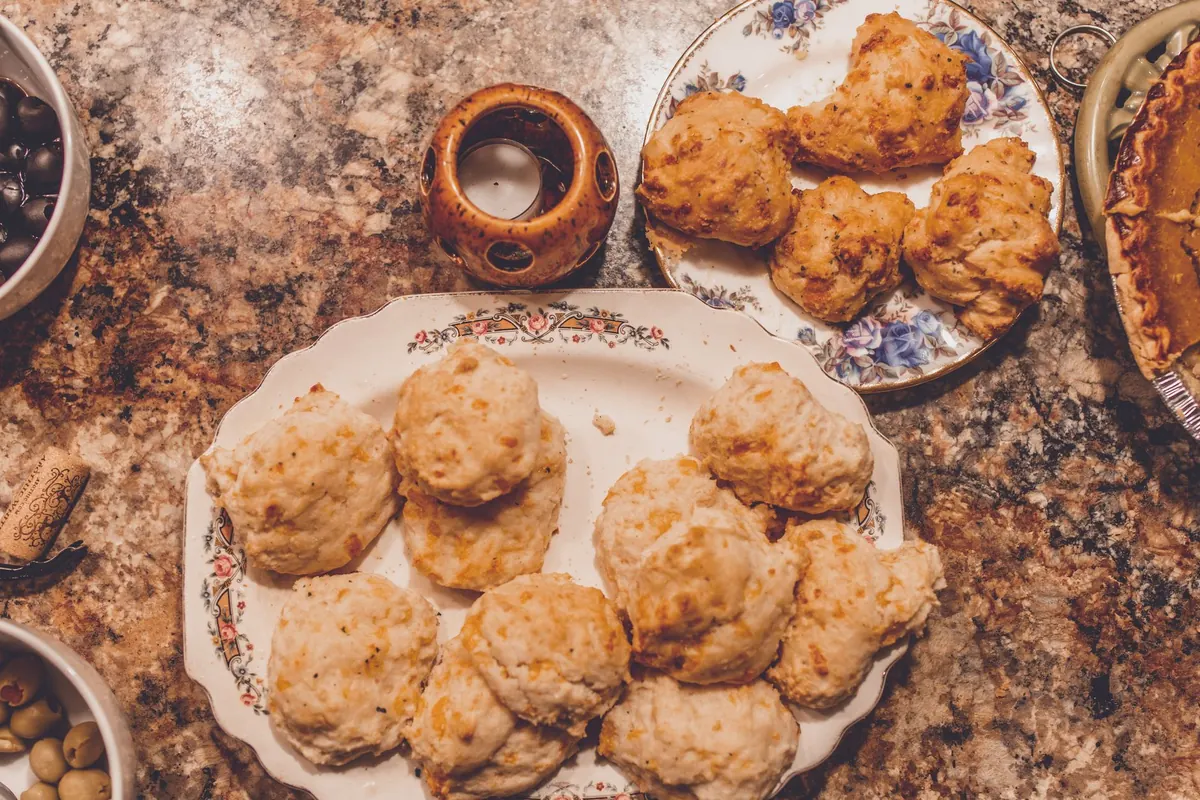
A scone is a very cold, very buttery delivery system. Take the dough you already trust for a sweet cream scone, pull the sugar out, and steer it toward sharp cheddar, a fistful of chives, and more black pepper than feels reasonable. What comes out is biscuit-adjacent but finer: a flaky break, a lace of melted cheese around the base, and enough backbone to sit next to eggs, arugula, or a bowl of tomato soup without asking for jam.
This is the version that gets made on repeat in my kitchen, and the formula underneath it is loose enough to bend toward whatever is in the fridge on a Sunday morning.
Savory scones fail in two directions. They go dry and chalky, usually because the dough was lean and the oven ran long. Or they go soft and cakey, because too much liquid met too much handling and the gluten developed into something closer to a muffin.
The numbers that keep you in the middle are simple. For every 2 cups of all-purpose flour, plan on 1 tablespoon of baking powder, 8 tablespoons of cold butter, and about 3/4 cup of liquid. That is a high-fat, low-liquid dough, and it should look shaggy and slightly uncooperative before you shape it.
Two adjustments matter specifically for the savory version. First, sharp cheddar brings both salt and fat, so the added salt drops to about 3/4 teaspoon and the butter stays put — do not add more. Second, buttermilk does more work here than in a sweet scone. Its acidity balances the richness of the cheese and reacts with the baking soda to help the scones brown deeply rather than pale.
If you can still see distinct flakes of butter in the dough, you are doing it right.
This makes 8 generous wedges, enough for four people as part of a spread.
Once the base works, the rest is arithmetic. Per 2 cups of flour, use about 1 generous cup of total add-ins. Past that, the dough stops holding together and you trade flake for bulk. Three rules keep the swaps honest.
Cheese carries salt and fat. Feta, Parmesan, blue, and aged cheddar are all salty. When they are in the mix, drop the added salt to 1/2 teaspoon. Softer cheeses like goat or cream cheese also add moisture, so hold back a tablespoon of buttermilk.
Wet add-ins cost liquid. Roasted peppers, olives, caramelized onion, cooked bacon, pesto, and sun-dried tomatoes all bring water. Blot them dry, chop them small, and start with 2/3 cup of buttermilk instead of 3/4.
Cut everything to pea size. Anything larger tears the dough as you shape it. The exception is a deliberate pocket — a chunk of cheese pressed into the center of each wedge, which melts into a seam when baked.
Combinations that earn their place on a brunch table:
Smoked salmon is better as a topping than an ingredient. Baked into dough, it turns salty and tight; laid over a split, buttered scone with cream cheese and capers, it is exactly right.
Wedges give you crisp edges on three sides and require no rerolling, which is where most scone dough gets tough. If you prefer rounds, cut them with a sharp cutter and press straight down — twisting seals the layers shut and the scones rise sideways instead of up.
Cold butter is the whole mechanism. It creates steam in the oven, and steam pushes the layers apart. If the dough starts feeling greasy or warm under your palms, slide the whole thing onto a plate and put it in the freezer for ten minutes.
Fifteen minutes in the refrigerator before the pan goes into the oven firms the butter back up and hydrates the flour. It is the single easiest upgrade to a scone that spreads too much.
High heat and a hot start give you the color. Bake at 425°F and resist opening the door for the first fifteen minutes. Rotate the pan at that point if your oven runs uneven, and expect the loose cheddar on top to melt and spill down the sides into a crisp, frico-like skirt. That is the best part; do not scrape it off the parchment.
The scones are done when they are deep gold, firm on top, and feel light for their size. If you want a number, an instant-read thermometer in the center reads around 200°F. Cool them on the pan for ten minutes — the interior is still setting, and cutting early gives you a gummy crumb.
Cut the wedges, freeze them solid on the pan, then bag them. Bake from frozen at 400°F, adding four to six minutes to the time. This is the move for a brunch where you would rather be making coffee than measuring flour at 8 a.m.
For baked scones, reheat at 300°F for 8 to 10 minutes, or split one and toast the cut sides in a buttered skillet. A microwave will steam them into rubber, so skip it. Leftovers keep two days in a sealed container at room temperature; beyond that, freeze them.
These scones are the starch, so keep the rest of the plate bright and light. A bowl of citrus segments with olive oil and flaky salt, soft scrambled eggs, and something pickled — quick onions, cornichons, a jar of pepperoncini — cut through the butter and cheese. If you want to make them the main event, split one warm, butter it, and stack it with a fried egg, a slice of tomato, and a handful of arugula.
For a crowd, mix the dry ingredients the night before and leave them covered on the counter. Grate the cheese, chop the chives, and cube the butter, then store each separately in the fridge. In the morning you are fifteen minutes from a tray in the oven, and the kitchen will smell like toasted cheese and black pepper before anyone arrives.
Photo: Ylanite / Pixabay

Adapt any scone recipe to seasonal fruit and herbs by adjusting liquid, sugar, and technique — with pairing ideas, a...

Freeze shaped scone dough and bake it straight from the freezer for a taller, flakier rise. Here is how to wrap,...
Gluten-free scones fall flat because the flour, binder, and timing all work differently. Here's how to balance...

Cozy scones and quiet moments..
